At a glance
- Hours
- 09:00–20:00; Jung-gu District lists the 1st and 3rd Sundays of each month as closing days
- Getting there
- Metro Line 1: Jagalchi Station Exit 7 or Nampo Station Exit 1, both about 10 minutes on foot
- Size
- Roughly 1,489 shops across about 650 businesses, in six numbered zones
- Address
- 42 Junggu-ro, Jung-gu — market office 051-245-7389
- Next door
- Bupyeong Kkangtong Market, whose night market runs 19:30–24:00 year-round
- Payment
- Cash at small stalls; larger shops take cards
A market the war built
Gukje Market began after Korea's liberation in 1945, when traders started selling off controlled wartime goods in this part of Jung-gu. The Korean War turned it into something much larger: Busan took in enormous numbers of refugees, and the market became how many of them made a living.
While the US Army was stationed at Busan Port, smuggled foreign goods and UN military supplies were traded here too. That history is the reason the market sells such an unrelated spread of things — it was never planned, it accumulated.
It is not a maze. It is six zones
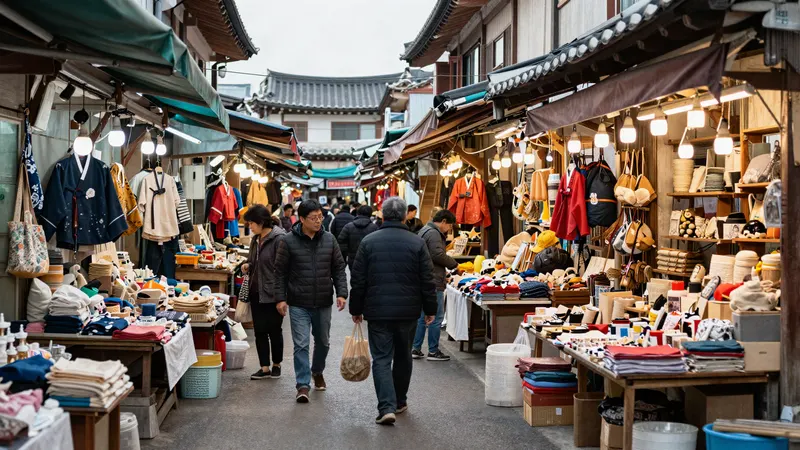
Every guide calls Gukje Market maze-like, and on a first visit it is. But the market is formally divided into six numbered zones, each with its own trade, and knowing which zone you want turns an hour of wandering into a ten-minute walk.
| Zone | What it sells |
|---|---|
| Zone 1 | Bags, stationery, handicrafts |
| Zone 2 | Kitchen utensils, ironware, opticians |
| Zone 3 | Bedding, boutique clothing |
| Zone 4 | Fabric — linen, cotton, silk, brocade — and kitchenware |
| Zones 5 and 6 | Household appliances, machine tools, textiles |
Zone 3's other reputation: Korean quilts
Zone 3's bedding shops have become a specific draw for Taiwanese visitors in particular. Several storefronts here now fly Taiwan's flag and post Chinese-language signs reading "Taiwan customer special discount," and some shop owners have hired Taiwanese or Chinese-speaking staff to keep up with demand that built from 2023 and accelerated through 2025 and 2026 — tracking a broader shift in which Taiwan overtook China in the first half of 2026 as the most common nationality among Busan's foreign visitors.
The appeal is cost-performance rather than novelty: Korean quilts are seen as well-made for the price, and Taiwan's mild year-round climate means a single quilt gets used for years, which makes paying for quality worth it. Shops handle the bulk with vacuum-sealed packing and batch outgoing orders for air shipment, so carrying one home isn't the obstacle it looks like. Not every visitor to a group is there to buy — merchants report that plenty come along out of curiosity and end up purchasing after trying a quilt at home.
The two Sundays it is closed
The market runs 09:00 to 20:00. Jung-gu District lists the first and third Sunday of each month as closing days, though Visit Busan simply says Sundays and some shops open regardless — if Sunday is your only day, call the market office on 051-245-7389 first. A closed Sunday catches people out, because the surrounding district — BIFF Square, the street food, the cinemas — carries on as normal while the market itself is shuttered.
Individual shops keep their own hours within that window, so the edges of the day are unreliable: arriving at 09:15 or 19:45 means a lot of closed shutters even on an open day. Mid-morning to early evening is when the market is actually full.
The night market next door
Bupyeong Kkangtong Market is a separate market a few minutes away, and it is the one to know about for evenings. Its daytime hours run 09:00 to 20:00, but the night market operates 19:30 to midnight, year-round — it opened in October 2013 as Korea's first permanent night market.
The name comes from cans. After the Korean War the market specialized in tinned food smuggled out of US military supplies, and kkangtong is simply the Korean word for a can. Today it trades in food, clothing, accessories and imported goods.
The practical point is the timing: Gukje shuts at 20:00, Bupyeong's night market starts at 19:30. If you arrive in the late afternoon you can do both in sequence without a gap.
What is actually worth buying
Gukje Market is a browsing market rather than a souvenir shop, and going in with a fixed shopping list is the wrong approach. Fabric in Zone 4 is genuinely cheap by international standards, kitchenware in Zone 2 is the sort of thing Korean households actually buy, and the food alleys throughout are the reason many locals come at all.
What it is not is a bargain electronics market or a place to find things you cannot get elsewhere. Treat it as a walk through a working market with unusually deep history rather than a shopping destination, and it delivers. For actual shopping, other districts are a better use of an afternoon.
- Carry cash for small stalls; larger shops take cards
- Prices at stalls are often negotiable in a mild way — one round, not a performance
- Weekends are noticeably busier than weekdays
- The market connects on foot to Jagalchi and BIFF Square, so plan them as one loop
- The City Tour Orange line stops here if you would rather not work out the metro — see the City Tour Bus guide
Frequently asked questions
What are Gukje Market's opening hours?
09:00 to 20:00. Jung-gu District lists the first and third Sunday of each month as closing days, while Visit Busan says Sundays, so call 051-245-7389 before a Sunday visit. Individual shops keep their own hours inside that window, so arriving right at opening or close means a lot of shuttered stalls. Mid-morning to early evening is when the market is properly full.
How do I get to Gukje Market?
Metro Line 1 to Jagalchi Station Exit 7, or Nampo Station Exit 1 — both about a ten-minute walk. It sits in Nampo-dong next to BIFF Square and a short walk from Jagalchi Market, so the three combine naturally into one outing.
How is Gukje Market laid out?
It is divided into six numbered zones: Zone 1 bags, stationery and handicrafts; Zone 2 kitchen utensils, ironware and opticians; Zone 3 bedding and boutique clothing; Zone 4 fabric and kitchenware; Zones 5 and 6 household appliances, machine tools and textiles. Asking for a zone number is far more effective than asking for an item.
What is the difference between Gukje Market and Bupyeong Kkangtong Market?
They are separate markets a few minutes apart. Gukje is general goods across six zones and closes at 20:00. Bupyeong Kkangtong is food-focused, runs 09:00 to 20:00 in the day, and its night market operates 19:30 to midnight year-round — it opened in October 2013 as Korea's first permanent night market.
Why is it called Kkangtong Market?
Kkangtong is the Korean word for a can. After the Korean War the market specialized in tinned food smuggled out of US military supplies, and the name stuck even though it now sells food, clothing, accessories and imported goods.
Is Gukje Market worth visiting?
As a walk through a working market with unusually deep history, yes. As a shopping destination, less so — it is not a bargain electronics market and does not stock things you cannot find elsewhere. Fabric, kitchenware and the food alleys are the parts that reward attention.
Do I need cash at Gukje Market?
For small stalls, yes. Larger shops increasingly take cards, but carrying some cash is the safer approach and is necessary at the food stalls.
Why are there Taiwanese flags on shops in Gukje Market?
Zone 3's bedding shops have become a specific draw for Taiwanese visitors, who buy Korean quilts for their price-to-quality ratio. Several storefronts now display Taiwan's flag and Chinese-language signs, and some have hired Taiwanese or Chinese-speaking staff to keep up with demand that built from 2023 and accelerated through 2025 and 2026. Shops typically handle shipping with vacuum-sealed packing and batched air freight.