At a glance
- Nampo-dong
- Street shops, two markets, Olive Young's biggest Busan store and Lotte's Gwangbok store, all near Jagalchi
- Seomyeon
- Underground arcade, Lotte's Busan main store and the Jeonpo cafe streets, at the Line 1–2 transfer
- Centum City
- Department store and mall shopping under one roof, beside Centum City Station
- Gwangalli & Millak
- Beachfront shops and a late-opening Olive Young, open until 23:00
- Osiria
- Lotte's outlet and mall complex in Gijang, about 1 km from Haedong Yonggungsa
- Used most by visitors
- Street-level shops (75.1%), then traditional markets (48.2%)
- Tax refund
- Spend ₩15,000 or more on one receipt at a tax-free shop and show your passport
Where visitors actually shop
Department stores are the obvious picture of shopping in Busan, but they are not where most visitors shop. In the city's survey of foreign visitors for July to December 2025, where each could name up to three places, 75.1% shopped at street-level shops, 48.2% at traditional markets and 43.5% at department stores, ahead of outlets and large malls (35.4%) and hypermarkets (34.2%).
Street shops came first for every nationality group the survey reports: 84.0% of visitors from the US and Canada and 81.3% from Europe. Only visitors from Hong Kong chose department stores at anything like the same rate (70.6%), and Taiwanese visitors were the most likely to head for outlets and malls (46.3%).
Card data shows where that spending is growing. In the 12 months to June 2026, sales on foreign-issued cards in Busan rose 60.0% on the year, according to Korea Credit Data — faster than Jeju (53.1%) or Seoul (36.4%). By neighborhood the biggest jump was Nampo-dong, up 143.0%, followed by Millak-dong (105.8%), Gwangan-dong (101.2%) and Jeonpo-dong (100.2%). Most of it is food, though: restaurants took 57.7% of those card sales.
Nampo-dong: street shops, markets and Busan's biggest Olive Young
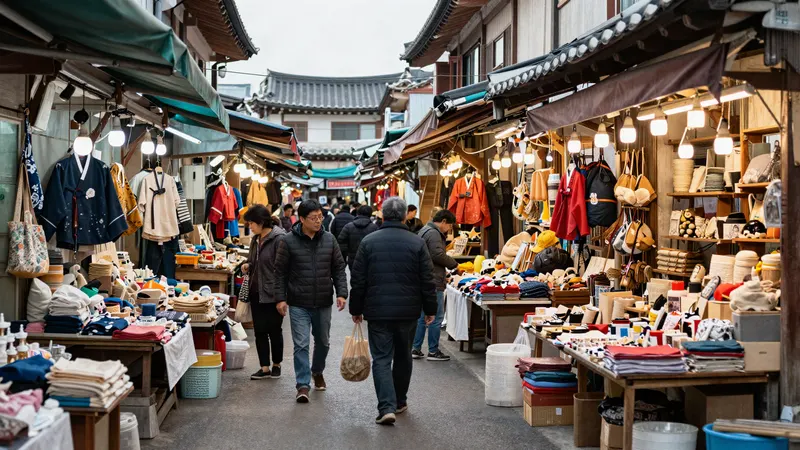
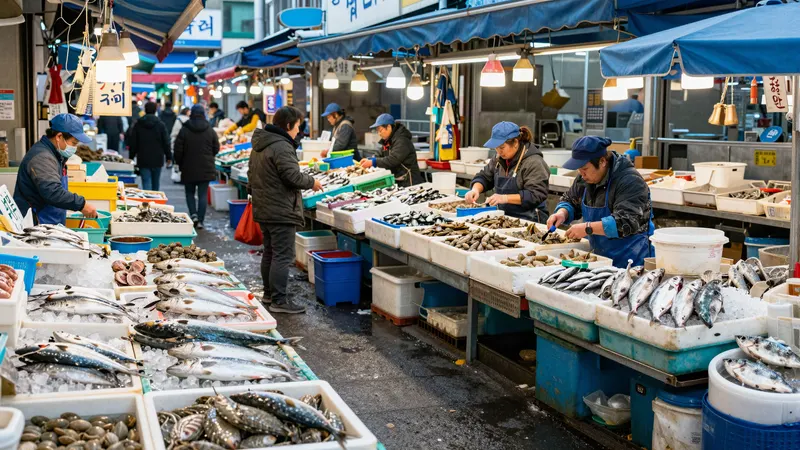
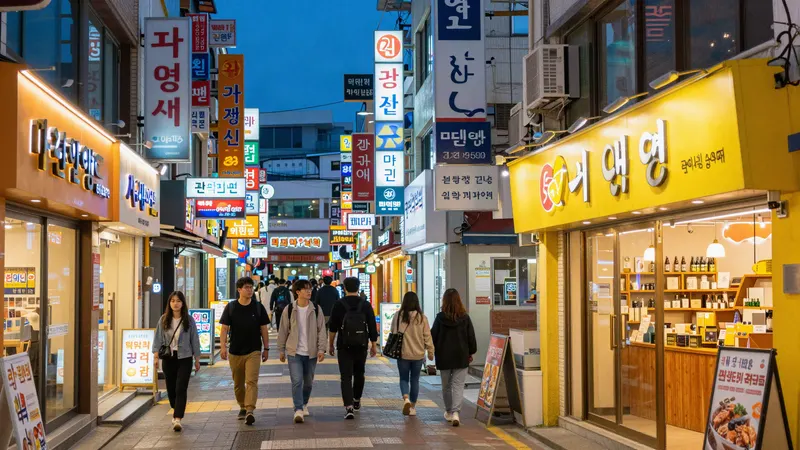
Nampo-dong is Busan's older commercial core, with shopping spread along the streets rather than inside one mall. It sits beside Jagalchi Market and BIFF Square, and Gukje Market and Bupyeong Kkangtong Market are a short walk north, so one outing covers street shops, both kinds of market and the harbor.
It is also where Olive Young opened its largest store outside the Seoul region. Olive Young Nampo Town moved to a four-floor, roughly 3,000-square-meter building on a main road in Nampo-dong on August 28, 2026, with a dermocosmetics zone, a 'mask pack library' and skin consultations. In its first two weeks, 72% of its sales came from foreign customers, the company says.
Lotte Department Store's Gwangbok branch connects directly to the basement from Exit 8 of Nampo Station on Line 1. On its Naver listing it opens 10:30–20:00 on weekdays and to 20:30 at weekends.
Seomyeon: underground mall and the nightlife hub
Seomyeon is Busan's central transit hub, where Lines 1 and 2 meet, and its main nightlife and youth fashion district. A large underground shopping arcade connects directly to the subway station, useful on a hot or rainy day, and the streets above are dense with fashion retailers, cosmetics shops and restaurants.
Lotte Department Store's Busan main store is here; the company says its foreign sales rose 150% in the first half of 2026. One stop east on Line 2, Jeonpo is known for independent shops and cafes, and its foreign card sales roughly doubled in the year to June 2026.
Centum City: large-format malls
Centum City is home to some of Busan's largest department stores and shopping complexes, oriented more toward a full-day mall experience — food courts, cinemas and a wide range of retail under one roof. Shinsegae Centum City sits beside Centum City Station on Line 2 and, on its Naver listing, opens 10:30–20:00 on weekdays and to 20:30 at weekends. It's a reasonable stop if you want air-conditioned, one-stop shopping, though it has less of the street-level character of Nampo-dong or Seomyeon.
Gwangalli and Millak: shopping after the beach
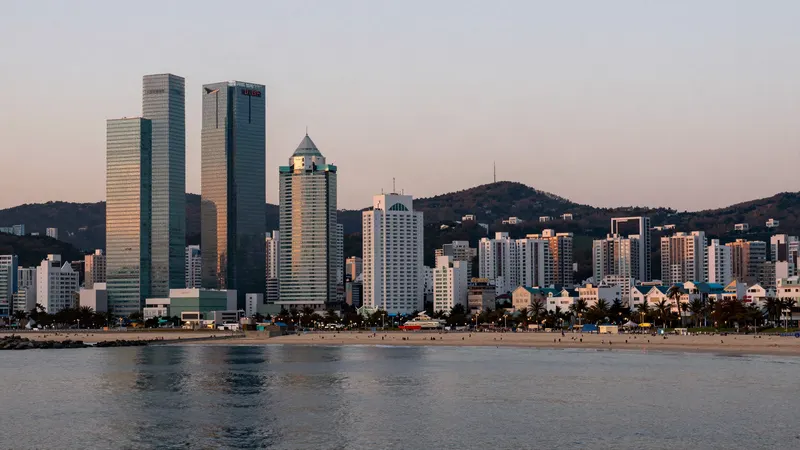
The streets behind Gwangalli Beach are not a shopping district in the way Seomyeon is, but they are where foreign spending is climbing: Millak-dong's foreign card sales rose 105.8% and Gwangan-dong's 101.2% in the year to June 2026, and Olive Young says its stores around Gwangalli and Millak grew foreign sales by an average of 212% a year from 2023 to 2025.
Olive Young opened a store at Millak The Market on August 30, 2026, at 56 Millaksubyeon-ro 17beon-gil. It is the first Olive Young with a freezer section, and it stocks snacks and wellness products alongside cosmetics. Its Naver listing shows 10:00–23:00, late enough for after the bridge lights come on. The nearest subway is Gwangan Station on Line 2, about 20 minutes on foot.
Osiria: Lotte's outlet and mall on the east coast
Osiria is a resort district in Gijang, north of Haeundae, with Lotte's outlet and mall complex at 147 Gijanghaean-ro. Lotte says its Lotte Mall Dongbusan store grew foreign sales by 170% in the first half of 2026, and the Busan Institute names Gijang-eup as one of the city's premium shopping zones for foreign spending.
It pairs naturally with Haedong Yonggungsa, about 1 km away, or Lotte World Adventure Busan nearby. Osiria Station on the Donghae Line is the nearest rail stop. By bus, the complex's listing names the stop at the Dongbusan tourist complex, served by express bus 1001 and buses 100, 139, 181 and 185. The listing shows 10:30–21:00.
What visitors buy
The most common purchase is food. 54.3% of foreign visitors bought food and drink — tea, snacks, alcohol — ahead of clothing (42.8%), souvenirs and crafts (38.7%) and perfume or cosmetics (27.5%). That puts the food stalls of Gukje Market and the humble convenience store firmly on a shopping list: in the Busan Institute's card data, convenience stores were where foreign cards were used most often in 2025, with 1.88 million transactions.
Among visitors who shopped, the average spend was $152.40 per person. Across everyone, including those who bought nothing, it was $116.50.
Spending by value tells a different story. Department stores were the largest single category of foreign card spending in 2025, at an estimated ₩132 billion, followed by cosmetics at ₩92 billion: fewer visitors, bigger bills. The report singles out the area around Busan Station and the port, where many visitors arrive, as a cosmetics-led 'beauty' zone, and names districts in Haeundae and in Gijang-eup, home to the outlet malls at Osiria, as premium shopping zones.
What to buy at Olive Young
Olive Young is Korea's largest health and beauty chain, and for many visitors it is the main shopping stop. Foreign customers made up 33% of its in-store sales in January to August 2026, up from 2% in 2022, and the company says 88% of all cosmetics purchases processed by the tax refund firm Global Tax Free in 2025 were made at its stores.
Olive Young does not publish a list of the brands foreign shoppers buy most, so we don't give one. What it does publish is the categories. Foreign customers buy the full basic routine — cleansing, skin care, sheet masks and sunscreen — and the number doing so rose from 12,000 in 2019 to 569,000 in 2025. In 2026 the fastest-growing categories among foreign shoppers were dermocosmetic skin care, up about 78%, and 'inner beauty' supplements, up 64%. Most visitors don't stop at one brand: 58% bought six or more.
A practical way to shop: decide on the categories you want, then use the ranking section of Olive Young's app or website, or the in-store consultants at Nampo Town, to choose within them. Sheet masks are the easiest gift to carry, since they are light and flat.
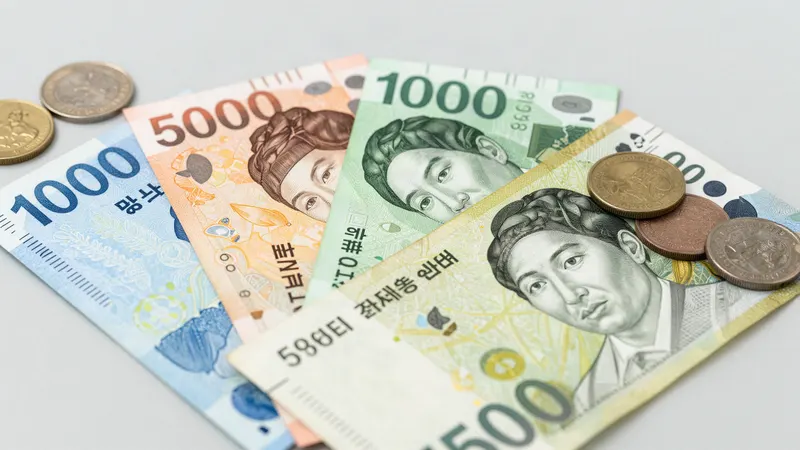
Ask for tax-free at the counter and show your passport. Korea's tax refund applies to purchases of ₩15,000 or more on one receipt at participating shops, and the immediate refund at the till covers up to ₩1 million per purchase and ₩5 million per trip.
What to buy at a convenience store
Korean convenience stores — CU, GS25, 7-Eleven — are the most-used shops for foreign visitors in Busan by number of transactions, and the chains have started reporting what those customers pick up. In 2026, CU named Binggrae banana milk, a Dubai-style chewy cookie and its Hansonhankki chocolate snack among foreign customers' popular items. GS25 named banana milk, Gamdongran seasoned boiled eggs, Greek yogurt, the chewy cookie series, K-pop albums and celebrity-branded drinks.
In summer 2026, GS25 said foreign spending at its coastal stores — Haeundae among them — rose 136.9% on the year for July 1–19, led by banana milk, Greek yogurt, instant ramyeon and honey butter almonds.
Convenience stores are also where you top up a T-money card and, at some branches, pick up a SIM card. Ramyeon and seasoned laver are light, cheap snacks to pack for home.
Quick comparison
| Area | Best for | Nearest station |
|---|---|---|
| Nampo-dong | Street shops, markets, Olive Young Nampo Town | Nampo, Line 1 |
| Seomyeon | Fashion, cosmetics, underground arcade, nightlife | Seomyeon, Lines 1 and 2 |
| Centum City | Air-conditioned, one-stop mall shopping | Centum City, Line 2 |
| Gwangalli & Millak | Evening shopping after the beach | Gwangan, Line 2 |
| Osiria | Outlet shopping, paired with Haedong Yonggungsa | Osiria, Donghae Line |
Frequently asked questions
Where is the best shopping in Busan?
It depends what you want. Nampo-dong has street shops, Gukje and Bupyeong Kkangtong markets and Olive Young's largest Busan store, close to Jagalchi Market and BIFF Square. Seomyeon is the central transit hub with a large underground arcade and Lotte's Busan main store. Centum City holds some of the city's largest department stores, and Osiria has Lotte's outlet and mall complex.
What is the difference between Seomyeon and Centum City for shopping?
Seomyeon is street-level and underground shopping in a dense, central district that doubles as Busan's main nightlife and youth fashion area, at the transfer between Lines 1 and 2. Centum City is oriented toward a full-day mall experience — food courts, cinemas and a wide range of retail under one roof — with less of the street-level local character.
Where should I shop on a rainy day in Busan?
Seomyeon's large underground shopping arcade connects directly to the subway station, which makes it useful on a hot or rainy day. Lotte's Gwangbok store also connects straight from Exit 8 of Nampo Station, and Centum City's indoor malls work for the same reason.
Where do foreign visitors shop most in Busan?
At street-level shops. In Busan's survey of foreign visitors for July to December 2025, 75.1% shopped at street-level shops, 48.2% at traditional markets and 43.5% at department stores, ahead of outlets and large malls (35.4%) and hypermarkets (34.2%). By card data, Nampo-dong saw the fastest growth in foreign spending in the year to June 2026, up 143.0%.
What should I buy at Olive Young in Korea?
Olive Young doesn't publish a brand ranking for foreign shoppers, but it says they buy the full basic routine — cleansing, skin care, sheet masks and sunscreen — and that dermocosmetic skin care and 'inner beauty' supplements were the fastest-growing categories in 2026. Choose the categories first, then use the ranking in Olive Young's app or ask a consultant.
Can I get a tax refund at Olive Young?
Yes, at participating stores. Ask for tax-free at the counter and show your passport. Korea's tax refund applies to purchases of ₩15,000 or more on one receipt, and the immediate refund at the till covers up to ₩1 million per purchase and ₩5 million per trip.
What do foreign visitors buy at Korean convenience stores?
Banana milk is the constant. In 2026 reports, CU also named a Dubai-style chewy cookie and its Hansonhankki chocolate snack, and GS25 named seasoned boiled eggs, Greek yogurt, instant ramyeon, honey butter almonds and K-pop albums.