At a glance
- Does T-money work in Busan?
- Yes. It is a nationwide card — one bought in Seoul works here, and vice versa
- Card price
- Roughly 2,500–4,000 KRW for the card itself, with no travel credit included
- Subway fare with a card
- 1,600 KRW up to 10 km, 1,800 KRW beyond — 100 KRW less than a single-journey ticket, and only cards get transfers
- Transfers
- Free or discounted within 30 minutes of tapping off, up to two per journey. Card only, and never twice on the same route number
- Where to buy
- Any CU, GS25 or 7-Eleven counter, or a subway station machine with an English menu
Yes, T-money works in Busan
This is the question people arrive with, so: T-money is a nationwide card. One bought in a Seoul convenience store works on Busan's subway and buses without any registration, and a card bought here works in Seoul on the way home.
Busan also issues its own card, Cashbee, and the two are interchangeable for a visitor's purposes — both are accepted on the subway, city buses and most taxis. Whichever you are handed is fine. There is no visitor-specific card you need to hunt for.
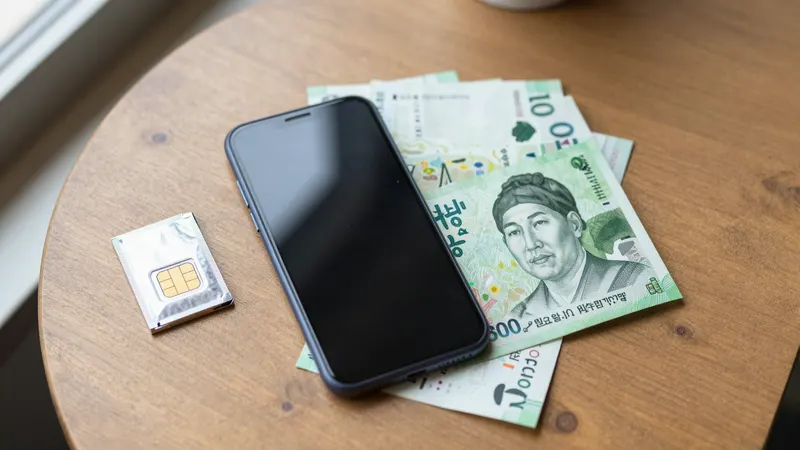
You do not need a bank account, ID, phone number or app. It is prepaid plastic: load cash on, tap, the balance goes down.
What it actually saves you
Busan's subway charges by distance in two zones. With a transit card the adult fare is 1,600 KRW for journeys up to 10 km from your starting station and 1,800 KRW beyond that. A single-journey ticket costs 100 KRW more in each zone.
The hundred won is not the real saving. Single-journey tickets get no transfer discount at all, so a trip involving a bus and a subway leg costs two full fares without a card and close to one with it. On a normal sightseeing day that difference is several thousand won.
| Adult fare | With transit card | Single-journey ticket |
|---|---|---|
| Zone 1 — up to 10 km | 1,600 KRW | 1,700 KRW |
| Zone 2 — beyond 10 km | 1,800 KRW | 1,900 KRW |
| Transfers | Free or discounted | None |
Where to buy one
Convenience stores are the easiest source. CU, GS25 and 7-Eleven all sell cards at the counter for roughly 2,500–4,000 KRW. That price is for the card only — say how much credit you want and the cashier loads it in the same transaction.
If the rack is not obvious, the phrase to use is 교통카드 (gyotong-kadeu, transit card). Pointing at the card rack by the register works just as well.
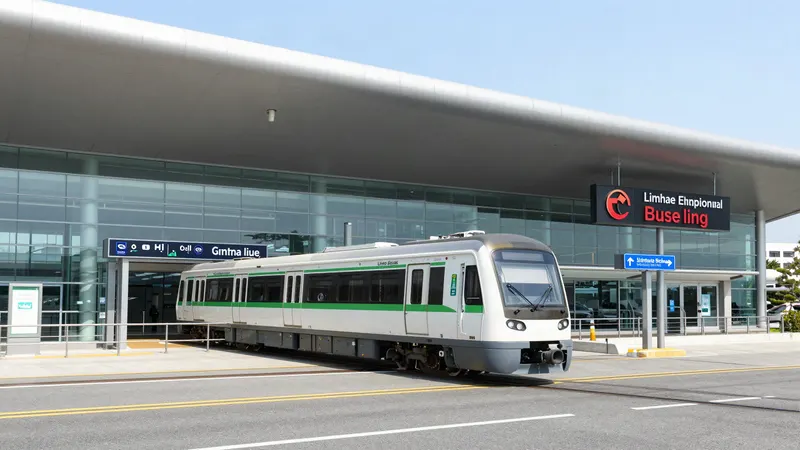
Subway station machines also sell and top up cards and have an English menu. At Gimhae Airport the practical move is to buy at the convenience store before you reach the light rail platform, so you are not learning a machine with luggage behind you.
- Card cost and travel credit are separate — load extra at the same counter
- A physical card is simpler for short visits than the phone versions, which have device and carrier restrictions
- Load in round amounts; 10,000 KRW covers roughly a day of ordinary sightseeing
How to tap — and the mistake that costs you
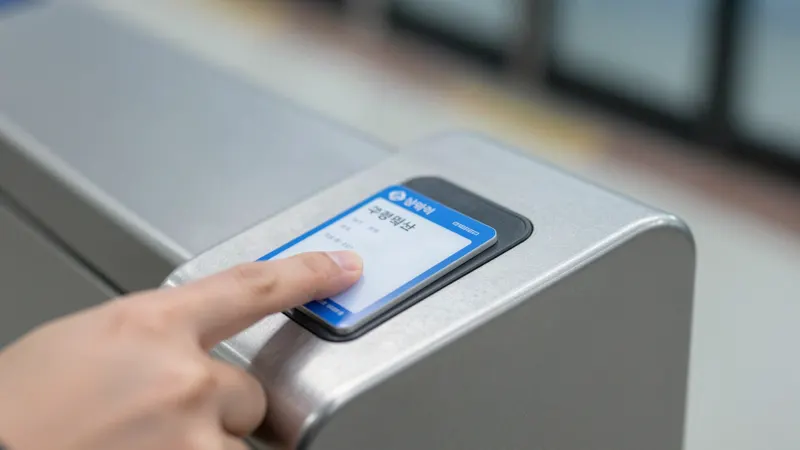
On the subway, tap on the turnstile reader going in and again going out. The distance-based fare is settled on the way out.
On buses, tap at the front door when you board and tap again at the rear door when you get off. That second tap is the one visitors skip, because in many countries buses are a single tap.
Skipping the tap-out does two things, both bad: it forfeits the transfer discount on your next leg, and on the subway — where the fare really is distance-based — it can charge you the maximum for that line rather than the distance you rode. City buses are flat-fare, so the missed tap costs you the transfer, not the ride itself.
How transfers work
Transfers between bus and subway, or between two buses, are free or discounted within 30 minutes of tapping out, for up to two transfers in a single journey. You have to be using a card and you have to tap on both ends of every leg — that is the whole condition.
One rule catches people out far more than the clock does: the same route number never counts twice, even with another vehicle in between. Riding bus 10 out and bus 10 back is two full fares. Airport limousine buses sit outside the scheme entirely, in both directions.
Leftover balance at the end of the trip
The simplest exit is to spend the balance down at a convenience store — T-money and Cashbee both work as ordinary payment there, so a last coffee or snacks for the flight clears it.
Refunds exist but are more trouble than they are usually worth for a small balance, and what is available depends on the card type and where it was issued. If you expect to come back to Korea, just keep the card: balances do not expire quickly and the card itself is reusable indefinitely.
Frequently asked questions
Does T-money work in Busan?
Yes. T-money is a nationwide transit card, so one bought anywhere in Korea works on Busan's subway, city buses and most taxis. Busan's own card, Cashbee, works the same way and the two are interchangeable for a visitor.
How much is the Busan subway with a T-money card?
1,600 KRW for an adult traveling up to 10 km from the starting station, and 1,800 KRW beyond that. A single-journey ticket is 100 KRW more in each zone and gets no transfer discount, which is where the card really pays for itself.
Where can I buy a T-money card in Busan?
Any CU, GS25 or 7-Eleven counter sells them for roughly 2,500–4,000 KRW for the card itself, credit not included. Subway station machines sell and top up cards too and have an English menu. At Gimhae Airport, buying at the convenience store is easier than using a machine with luggage in tow.
Do I need a Busan-specific transit card?
No. T-money is nationwide, and Busan's own Cashbee card is equally usable. There is no visitor-only card to look for, and no bank account, ID or app is needed for either.
How do transfers work?
Transfers between bus and subway, or between two buses, are free or discounted within 30 minutes of tapping out, up to two transfers per journey — three vehicles in all. You must pay by card and tap on and off every leg. Two things catch visitors out: the same route number never counts twice even with something else in between, so a there-and-back trip on one bus is two full fares, and airport limousine buses are excluded from transfers altogether.
What is the most common T-money mistake?
Forgetting to tap out when leaving a bus. Buses need a tap at the front door on boarding and another at the rear door on exit. Missing the second tap forfeits the transfer discount on your next ride. City buses charge a flat fare, so the bus fare itself does not change.
What should I do with leftover balance?
Spend it at a convenience store before you fly — both T-money and Cashbee work as ordinary payment there. Refunds are limited and depend on the card type and where it was issued, so for a small balance they are rarely worth the trouble. If you plan to return to Korea, keep the card; balances do not expire quickly.