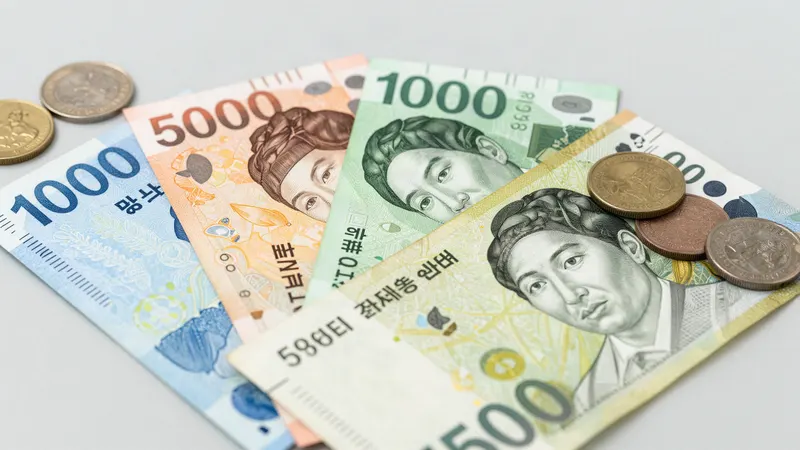
At a glance
- Currency
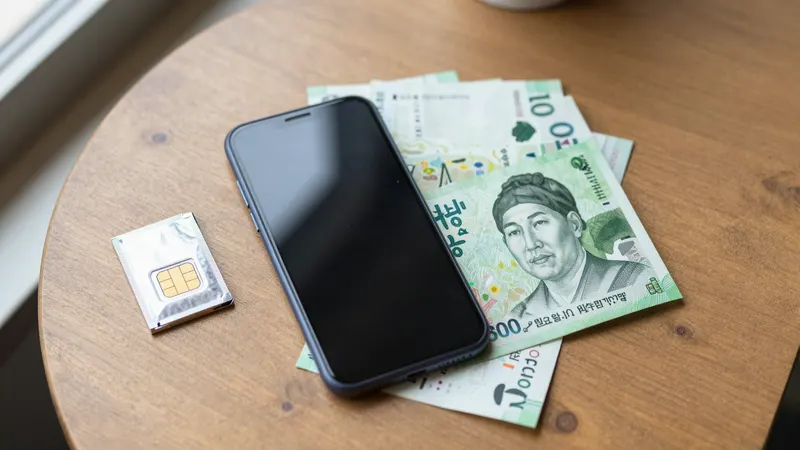
- Korean won (KRW, ₩). Notes are 1,000 / 5,000 / 10,000 / 50,000
- Cards
- Accepted almost everywhere, including taxis and convenience stores
- Cash still needed
- Market stalls, street food, some older restaurants, transit card top-ups
- ATMs
- Convenience store machines carrying Visa/Mastercard/Cirrus/Plus marks. Usually ₩1,000,000 max per withdrawal
- At the ATM
- Always choose to be charged in won, not your home currency
- Tipping
- Not practiced. No tip at restaurants, taxis or hotels
- Tax refund
- From ₩15,000 on one receipt at a participating shop, passport in hand
What a day in Busan actually costs
Some numbers to calibrate against, all from figures used elsewhere on this site. A metro ride is 1,600 KRW up to 10 km and 1,800 KRW beyond it, and city buses charge a single flat fare. A bowl of dwaeji gukbap runs about 10,000 KRW, a portion of samgyeopsal averaged 11,500 KRW in Busan in the Korea Consumer Agency's July 2026 survey, and an americano at a specialty cafe is 3,500–6,000 KRW.
For shopping, Busan's own visitor survey puts the average at $152.40 per person among those who bought anything. So a day of sightseeing, transit and two meals sits comfortably under 50,000 KRW per person before shopping or drinks.
Cards work almost everywhere — almost
Korea is among the most card-dependent countries in the world, and in Busan that includes taxis, convenience stores, cafes, department stores and most restaurants. Visa and Mastercard are accepted widely; American Express and Discover less so. Contactless works in the big chains, but many small terminals still want the chip inserted, and a few will ask you to sign.
The reliable exceptions are worth memorizing, because they are exactly the places visitors go: stalls inside Gukje Market and Jagalchi Market, street food carts, some older neighborhood restaurants, and topping up a transit card. Temple donation boxes and beach-side rentals are cash too.
One habit saves money everywhere: if a card terminal or ATM offers to charge you in your own currency, decline and pay in won. That option is dynamic currency conversion, and the rate is always worse than your bank's.
Getting cash out
Not every Korean ATM takes foreign cards. The ones that do carry the international network marks — Visa, Mastercard, Cirrus, Plus, UnionPay — on the machine, and the most dependable are inside convenience stores, which are open around the clock. Bank lobbies also have them, and the machines at Gimhae Airport arrivals work with foreign cards.
Expect a per-withdrawal cap around 1,000,000 KRW, plus a machine fee and whatever your own bank charges. Withdrawing larger amounts less often is cheaper than topping up daily. Screens have an English option; look for the language button before you insert the card, since some machines hide it afterwards.
If a machine rejects your card without explanation, try a different chain — the acceptance lists differ between the banks that operate the machines, and a card refused at one convenience store often works at the next.
Exchanging money, and the rate you actually get
Exchange rates in Korea run in a predictable order: private exchange booths in the city usually beat banks, banks beat the airport, and the airport beats exchanging won before you leave home. Bank branches keep office hours, roughly 09:00 to 16:00 on weekdays, which catches people out on weekends.
In Busan the booths cluster in Nampo-dong and Seomyeon. There are also unstaffed exchange kiosks from services like WOWPASS, which hand you a prepaid card loaded with won — useful outside bank hours, and installed at places including the Busan Port International Passenger Terminal. Whatever you use, count the notes before you walk away and keep the receipt.
You rarely need much. Cards cover most spending, so many visitors exchange 50,000 to 100,000 KRW for markets and street food and never need more.
Transit cards, and the one thing that needs coins
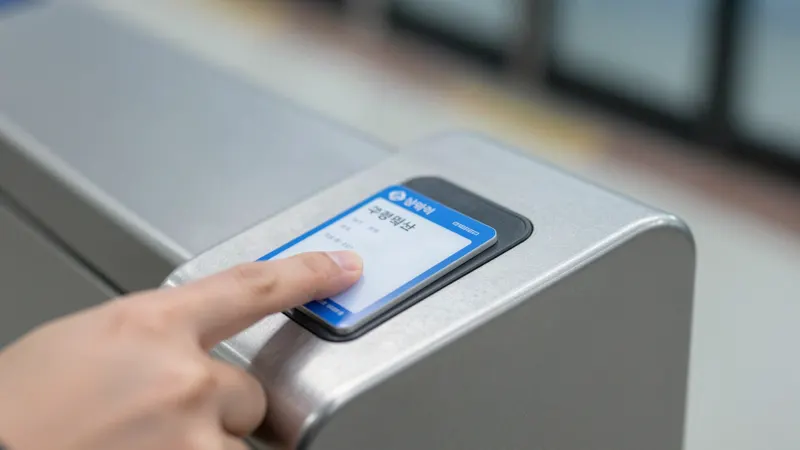
A T-money or Cashbee card is the smoothest way to pay for the metro, buses and many taxis, and it doubles as a payment card at convenience stores. The catch is that topping up is a cash transaction: the machines in stations and the counters at convenience stores take notes, not foreign cards.
So the practical pattern is to withdraw once, load the card with 20,000 or 30,000 KRW, and keep the rest of the cash for markets. Single-journey metro tickets cost 100 KRW more than the card fare in each zone and get no transfer discount, which is why the card pays for itself in a couple of rides.
Tax refunds for visitors
Foreign visitors can reclaim value-added tax on purchases at participating shops. The threshold is 15,000 KRW on a single receipt, and the immediate refund taken off at the till covers up to 1,000,000 KRW per purchase and 5,000,000 KRW for the whole trip. Bring your passport to the counter and say 'tax free' before paying.
Above those limits, or at shops that do not process it in store, you keep the receipts and claim at the airport kiosks before checking in your bags — customs may want to see the goods. Chains that cater to visitors, Olive Young and the department stores especially, handle the paperwork routinely.
Habits that make the money side easy
- Carry a mix of 1,000 and 10,000 KRW notes — market stalls dislike breaking 50,000s
- Tipping is not practiced and can confuse staff. The price on the menu is the price
- Restaurant bills are usually paid at the counter on the way out, not at the table, and one person pays for the table
- Tell your bank your travel dates if it blocks unfamiliar countries, and carry a second card in a different pocket
- Keep the taxi receipt: it carries the car number, which is what you need if something is left behind
- Coins pile up fast. Convenience stores will take them, and so will the transit card top-up machines
Frequently asked questions
Can I use a credit card everywhere in Busan?
Almost. Taxis, convenience stores, cafes, department stores and most restaurants take Visa and Mastercard. The exceptions are market stalls, street food carts, some older neighborhood restaurants and transit card top-ups, which are cash. American Express and Discover are accepted less widely.
Which ATMs in Busan accept foreign cards?
Machines carrying the Visa, Mastercard, Cirrus, Plus or UnionPay marks — most reliably the ones inside convenience stores, which are open 24 hours, plus bank lobbies and Gimhae Airport arrivals. Expect a cap near 1,000,000 KRW per withdrawal and a machine fee on top of your own bank's charge.
Should I exchange money before arriving in Korea?
Only a little, if at all. Rates are usually better at city exchange booths than at the airport, and better at the airport than buying won abroad. Banks keep weekday hours of roughly 09:00 to 16:00; unstaffed exchange kiosks cover the rest of the time.
How much cash should I carry in Busan?
Most visitors are comfortable with 50,000 to 100,000 KRW for markets, street food and transit card top-ups, and put everything else on a card. Keep small notes: stalls dislike breaking 50,000 KRW bills.
Do I tip in Busan?
No. Tipping is not practiced in Korea, including at restaurants, taxis and hotels, and an attempt to tip is more likely to cause confusion than pleasure. The listed price is the final price.
How does the tax refund work in Korea?
Spend 15,000 KRW or more on one receipt at a participating shop and show your passport. The immediate refund deducted at the till covers up to 1,000,000 KRW per purchase and 5,000,000 KRW per trip; beyond that, claim at the airport kiosks before checking your bags.