Save these before you land
- Police
- 112
- Fire and ambulance
- 119 — accepts text and video reports, and an interpreter can be brought onto the call
- Travel helpline
- 1330 — phone and chat, with interpretation. From abroad, +82-2-1330
- Open ER or pharmacy
- e-gen.or.kr, the national emergency medical portal
- Late-night pharmacy
- Busan designates 19 that open 22:00–01:00, year-round
- Disaster alerts in English
- Emergency Ready App, from the Ministry of the Interior and Safety
- Swimming
- Only inside the marked zones while lifeguards are on duty, 09:00–18:00 in season
What actually goes wrong here
Busan is an easy city to feel safe in, and most visitors never deal with anything worse than a missing umbrella. The incidents that do send travelers looking for help are rarely crimes: they are rip currents at the beach, a typhoon or a rainstorm that closes something, a stomach problem at 23:00 when the pharmacies have shut, and the ordinary confusion of explaining any of that in a language you don't speak.
So the useful preparation is not vigilance. It is four phone numbers, one app, and knowing that pharmacies keep short hours. Ordinary precautions still apply in crowds — Gukje Market, the Gwangalli fireworks, a Saturday night in Seomyeon — but they are the same precautions you would take anywhere.
The numbers, and how to get an interpreter
Korea splits emergencies between two numbers: 112 for police and 119 for fire and ambulance. Both work from any phone, including a foreign one roaming, and 119 also takes reports by text message and video call — useful if speaking is hard or you cannot describe where you are. The fire services can bring an interpreter onto a 119 call in a three-way connection, though which languages are available depends on the region and the hour.
For everything short of an emergency there is 1330, the Korea Tourism Organization's travel helpline. It does three things: tourist information, interpretation, and complaints about a tourist business. The interpretation is the part worth remembering — you can call from a shop, a clinic reception or a taxi and have the operator relay between you and the person in front of you. It runs by phone and by chat, and from outside Korea the number is +82-2-1330.
Two more worth having: 1345 is the Immigration Contact Center for visa and stay questions, and the e-gen portal at e-gen.or.kr, run by the National Emergency Medical Center, lists which emergency rooms and pharmacies are open right now near you.
| Number | For | Notes |
|---|---|---|
| 112 | Police | Crime, theft, a lost passport report |
| 119 | Fire, ambulance, rescue | Text and video reports accepted; interpreter can join the call |
| 1330 | Travel helpline | Information, interpretation, complaints. Phone and chat; +82-2-1330 from abroad |
| 1345 | Immigration Contact Center | Visa, stay and entry questions |
Medicine and clinics, and the hours that catch people out
Pharmacies are marked 약국 and are everywhere, but most are daytime businesses: many close by 19:00 or 20:00 and a good number shut on Sundays. That is the single most common medical problem visitors hit. Busan's answer is the public late-night pharmacy program — 19 designated pharmacies across the city that open 22:00 to 01:00, every day of the year, including holidays. The city publishes the current list as open data, and e-gen shows which pharmacy near you is open at this hour.
For a doctor, the distinction to know is 의원 (a small clinic, walk-in, cheapest, usually one specialty) versus 병원 and 종합병원 (hospitals). An emergency room is 응급실. Larger hospitals in Seomyeon and Haeundae are the likeliest to have English-speaking staff, but do not count on it at a neighborhood clinic in the evening — that is exactly the situation 1330's interpretation is for.
Bring your passport to any clinic or hospital. As a visitor you pay the non-resident rate up front and claim it back from your travel insurer, so keep the itemized receipt (진료비 영수증) and, for medicine, the prescription receipt.
The sea: rip currents are the real hazard
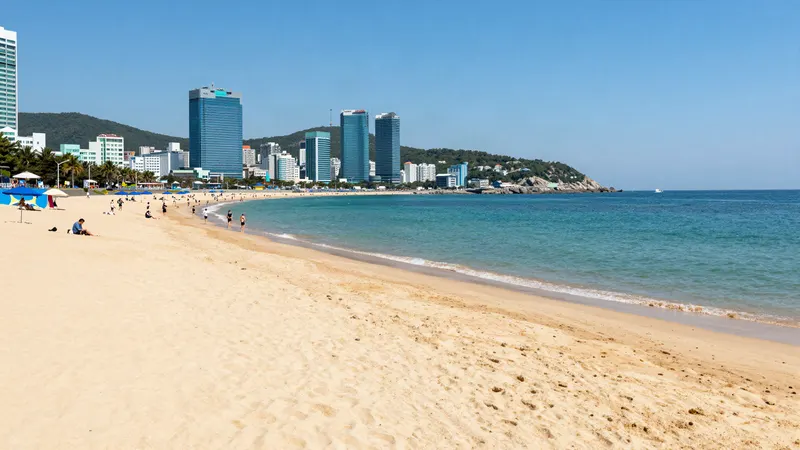
Busan's beaches look calm and are not always. Rip currents — 이안류 — pull swimmers away from shore, and Haeundae is one of the ten beaches nationwide where the Korea Hydrographic and Oceanographic Agency runs a real-time monitoring service during the June-to-September swimming season, now with AI-assisted detection on the beach CCTV feeds. The agency publishes a four-level rip current index, from watch to danger, and feeds it to the lifeguards on the sand.
You can check the same index yourself before you go, on the agency's site at khoa.go.kr or in its 'Safe Sea' app. On the beach, the rules that matter are simple: swim only inside the marked zones, only while lifeguards are on duty — 09:00 to 18:00 during the official season, which ran June 26 to September 15 in 2026 at Haeundae — and get out when the flags say so. Outside the season the beaches stay open for walking, but nobody is watching the water.
If you are caught in a current, the advice is the same as anywhere: do not swim straight back against it, swim parallel to the shore until it releases you, and raise an arm.
Typhoons, rain and the alerts on your phone
The rainy season lands in late June and July, and typhoons are possible from July through September. A serious one closes the coastal walkways, stops the cable car and occasionally the bridge, and can ground flights at Gimhae for a day.
Korea pushes emergency alerts to every phone in the affected area as loud cell broadcast messages. They arrive in Korean, with the disaster type tagged in English — 'Heavy rain', 'Earthquake' — and the Ministry of the Interior and Safety's Emergency Ready App carries the same alerts and safety guidance in English, Chinese and Japanese. Install it if you are traveling in the summer; it is the difference between a frightening siren and an instruction you can act on.
Practical version: if an alert mentions heavy rain, stay off the coastal paths and out of underground shopping arcades' lower entrances, and expect buses to reroute before the metro does.
Street rules that are enforced
- Cross at marked crossings. Jaywalking is an offense and the fine is real, though enforcement varies by district
- Bicycles, motorcycles and electric scooters are banned from the Haeundae beachfront walkway — the most commonly stopped visitors are on rented scooters
- Millak Waterside Park has been an alcohol-free zone since July 1, 2023, and several beaches ban fireworks, camping and cooking
- Smoking outdoors is restricted in many areas, including parts of the beaches and bus stops; look for the marked smoking cabins
- Tap water meets drinking standards, and most locals still drink bottled or filtered water out of habit rather than necessity
Losing something, and small trouble
Lost property is worth chasing in Korea. Start with the place itself — a station office, the restaurant, the cafe counter — then the nearest police box, marked 파출소 or 지구대. For anything left in a taxi, the receipt carries the car's number, which is what a dispatcher needs; take a photo of the receipt at the end of every ride and the problem solves itself.
If a purchase or a booking goes wrong, that is what 1330's complaint function is for. And if you are not sure whether something counts as an emergency, it is fine to call 1330 first and let the operator route you.
Words worth having on your phone
| Korean | Pronounced | Means |
|---|---|---|
| 도와주세요 | do-wa-ju-se-yo | Please help me |
| 119 불러주세요 | il-il-gu bul-leo-ju-se-yo | Please call 119 |
| 응급실 | eung-geup-sil | Emergency room |
| 약국 | yak-guk | Pharmacy |
| 여기가 아파요 | yeo-gi-ga a-pa-yo | It hurts here |
| 경찰서 / 파출소 | gyeong-chal-seo / pa-chul-so | Police station / police box |
| 영수증 주세요 | yeong-su-jeung ju-se-yo | Receipt, please |
Frequently asked questions
What is the emergency number in Busan?
112 for police and 119 for fire or ambulance, from any phone including a roaming foreign one. 119 also accepts text and video reports and can bring an interpreter onto the call. For non-emergencies, 1330 is the Korea Tourism Organization's travel helpline, with interpretation, by phone or chat.
How do I get help in English in Busan?
Call 1330. It offers tourist information, interpretation and complaint handling by phone and chat, and from abroad the number is +82-2-1330. The interpretation works as a relay: call from the shop, clinic or taxi and the operator translates between you and the person in front of you.
Where can I buy medicine at night in Busan?
Busan designates 19 public late-night pharmacies that open 22:00 to 01:00 every day of the year. Ordinary pharmacies, marked 약국, often close by 19:00 or 20:00 and many shut on Sundays. The national e-gen portal shows which pharmacy or emergency room near you is open right now.
Is it safe to swim at Haeundae Beach?
Inside the marked zones while lifeguards are on duty, yes. Rip currents are the main hazard, and Haeundae is one of ten beaches where the Korea Hydrographic and Oceanographic Agency runs real-time rip current monitoring during the June-to-September season, publishing a four-level index you can check on khoa.go.kr. The 2026 supervised season ran June 26 to September 15, 09:00 to 18:00.
How will I know if a typhoon is coming?
Korea broadcasts emergency alerts to every phone in the area. They are in Korean with the disaster type tagged in English, and the Ministry of the Interior and Safety's Emergency Ready App carries the same alerts and guidance in English, Chinese and Japanese. Typhoons are possible from July through September, and the rainy season is late June into July.
Do I need travel insurance for Korea?
Visitors pay non-resident rates up front at clinics and hospitals and claim afterwards, so insurance is worth having. Bring your passport to any appointment and keep the itemized receipt and prescription receipt for your claim.