At a glance
- What it is
- Chewy wheat-and-starch noodles in a chilled bone broth (mul-milmyeon) or in a red chili sauce (bibim-milmyeon)
- Where it comes from
- Refugees in wartime Busan who wanted naengmyeon but had wheat flour instead of buckwheat
- Official status
- Designated a Busan local food in 2006, according to Visit Busan
- Typical price
- Samseong Milmyeon lists 7,500 KRW on the city's certified list; a naengmyeon shop on the same street lists 14,000 KRW
- Easiest to try
- Halmae Gaya Milmyeon on Gwangbok-ro, Nampo-dong — open 10:30–21:30 every day
What's in the bowl
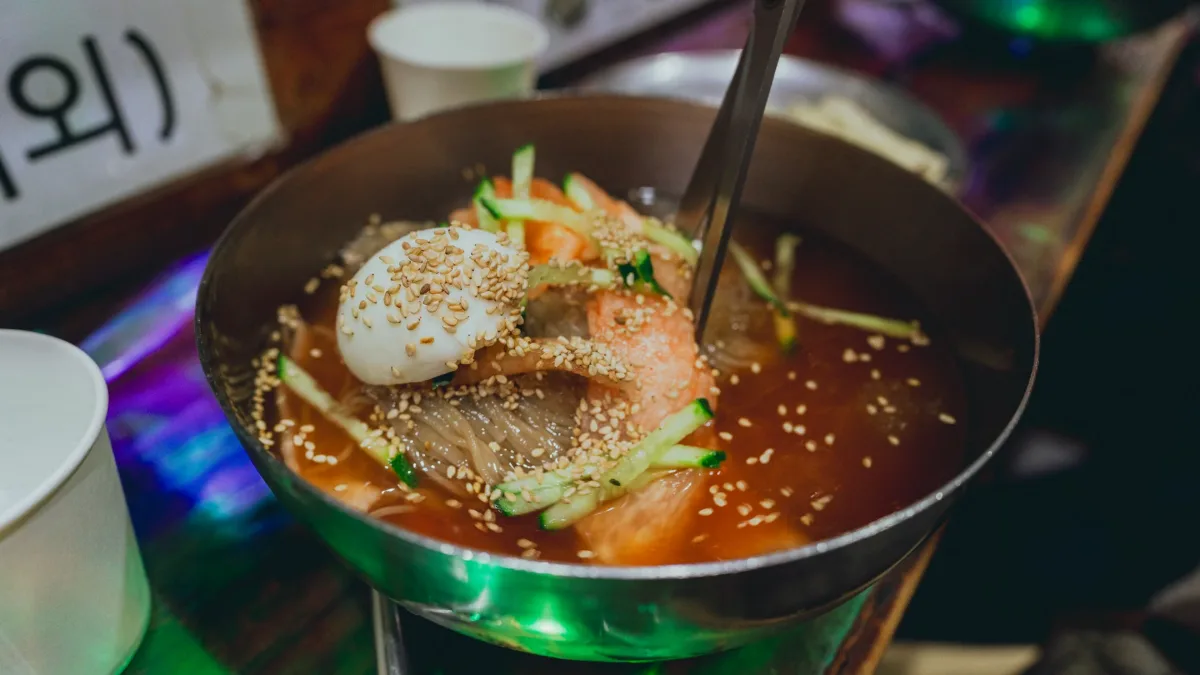
Milmyeon (밀면, roughly "meel-myun") is a cold noodle dish. The noodles are made from wheat flour mixed with starch, which makes them springier and chewier than the buckwheat noodles of naengmyeon; Visit Busan notes they are rinsed in iced water after cooking to firm them up further. The broth is usually made from pork or beef bones — some shops use chicken — and many add medicinal herbs such as licorice root, angelica and cinnamon, partly, Visit Busan says, to help digest the wheat.
It comes two ways. Mul-milmyeon (물밀면) is served in the cold broth, often half-frozen into slush in summer. Bibim-milmyeon (비빔밀면) has no broth and is tossed in a red chili sauce; it is the spicier one. Either way the usual toppings are half a boiled egg, which Visit Busan says people eat first, shredded radish and a spoonful of dadaegi (다대기), a red seasoning paste that sets how hot, sweet and sour the bowl ends up.
Born from aid flour in the war
During the Korean War, Busan filled with refugees from the north, and with them came their food. People from the provinces above the 38th parallel missed naengmyeon, but buckwheat and potato starch were hard to find. What was available was wheat flour sent as American aid. Visit Busan describes refugees mixing that flour with starch to make noodles they ate like naengmyeon, "the beginning of the milmyeon we eat today."
Accounts differ on the details — the Busan History and Culture Encyclopedia mentions potato starch, while Visit Busan's page on Uam-dong describes buckwheat stretched with wheat flour — and the encyclopedia is clear that there is no exact written record of milmyeon's beginnings. What everyone agrees on is that it was made in wartime Busan. The encyclopedia also records that the name started as mil-naengmyeon ("wheat naengmyeon") or "Gyeongsang-do naengmyeon" and was shortened to milmyeon.
Visit Busan dates its spread to the 1970s, its arrival as a signature city dish to the late 1990s, and its designation as a Busan local food to 2006. The encyclopedia groups it with Gupo noodles and dwaeji gukbap as one of the city's best-known refugee foods — the same history behind our dwaeji gukbap guide.
Naeho Naengmyeon: the shop said to have made the first
In Uam-dong, Nam-gu, Naeho Naengmyeon (내호냉면) is widely called the birthplace of milmyeon. According to the Busan History and Culture Encyclopedia, the family ran a naengmyeon restaurant called Dongchun Myeonok in Naeho-ri, Hungnam, from 1919, fled south during the war and opened in Uam-dong in 1952, naming the shop after their home village. The encyclopedia describes it as the oldest milmyeon restaurant in Busan, now run by the third generation, with milmyeon, bibim milmyeon and naengmyeon on the menu and warm noodles added in winter.
Uam-dong was a refugee settlement, and Visit Busan's page on the neighboring Somak Village — old cattle sheds that refugees turned into homes — suggests pairing a walk there with a bowl of milmyeon. The shop's address is 17 Uambeonyeong-ro 26beon-gil, Nam-gu. Visit Busan gives buses 134, 23, 26, 68, 138-1 and 168 to the Nambu Jungang Saemaeul Geumgo stop for Somak Village, about 3 minutes on foot; Naeho Naengmyeon is a short walk away, off the same road. Check its current hours before you go — neither page lists them.
Where to try it
All of these are on Busan Metropolitan City's certified restaurant list, which is where the hours and prices below come from. They change, so confirm in store.
Halmae Gaya Milmyeon (할매가야밀면) is the easiest for a first-timer: it is on Gwangbok-ro in Nampo-dong, a few minutes' walk from Gukje Market and Jagalchi, and the list gives 10:30–21:30, every day, for milmyeon and bibim milmyeon. On the same stretch of Gwangbok-ro, Wonsan Myeonok 1953 serves northern-style naengmyeon — the list prices Pyongyang and Hamheung naengmyeon at 14,000 KRW — so you can try both cold noodles on the same street.
Samseong Milmyeon (삼성밀면) in Busanjin-gu lists milmyeon at 7,500 KRW and jumulleok (marinated pork) at 8,500 KRW, open 10:30–18:00 and closed Tuesdays. Dangam Milmyeon (당감밀면) in Dangam-dong lists milmyeon and bibim milmyeon with hand-made dumplings and kalguksu, 11:00–20:00 with last orders at 19:30.
The encyclopedia also names two shops the city designated as Busan local-food restaurants in 2009: Chunhachudong (춘하추동) in Bujeon-dong, in the Seomyeon area, and Gaya Halmae Milmyeon (가야할매밀면) in Yeonsan-dong — not the same shop as Halmae Gaya Milmyeon in Nampo-dong, despite the similar name. Halmae Gaya, Samseong and Dangam are also pinned on our Cheap Eats Map.
Milmyeon or naengmyeon?
- Noodles: milmyeon is wheat flour with starch, so it is springy and chewy; naengmyeon is mainly buckwheat
- Broth: milmyeon is usually pork or beef bone, often with herbs; naengmyeon broth varies by style
- Origin: milmyeon began in wartime Busan; naengmyeon came from the northern provinces
- Price on the city's certified list: milmyeon 7,500 KRW at Samseong Milmyeon; naengmyeon 14,000 KRW at Wonsan Myeonok 1953
Frequently asked questions
What is milmyeon?
A Busan cold noodle dish of wheat-and-starch noodles, served either in a chilled bone broth (mul-milmyeon) or in a red chili sauce (bibim-milmyeon). It was created in wartime Busan by refugees who wanted naengmyeon but had wheat flour instead of buckwheat, and Visit Busan says the city designated it a local food in 2006.
What's the difference between milmyeon and naengmyeon?
Naengmyeon noodles are mainly buckwheat; milmyeon noodles are wheat flour with starch, so they are chewier. Milmyeon broth is usually pork or beef bone, often with herbs such as licorice and cinnamon. On Busan's certified restaurant list, milmyeon at Samseong Milmyeon is 7,500 KRW and naengmyeon at Wonsan Myeonok 1953 is 14,000 KRW.
Where did milmyeon start?
In Busan during the Korean War. Naeho Naengmyeon in Uam-dong, Nam-gu, opened in 1952 by a family from Hungnam that had run a naengmyeon restaurant there since 1919, is widely called its birthplace, though the Busan History and Culture Encyclopedia notes there is no exact written record.
Where can I eat milmyeon near Nampo-dong?
Halmae Gaya Milmyeon on Gwangbok-ro, a few minutes' walk from Gukje Market and Jagalchi, is on the city's certified restaurant list and open 10:30–21:30 every day. Wonsan Myeonok 1953 on the same street serves naengmyeon if you want to compare.
Should I order mul or bibim milmyeon?
Mul-milmyeon comes in cold broth and is the milder choice; bibim-milmyeon is tossed in red chili sauce and is spicier.