At a glance
- What it is
- Pork broth poured over rice, either in the same bowl or served separately
- Official status
- Named a Busan Future Heritage in July 2025
- Typical price
- Around 9,000–10,000 KRW a bowl
- Seasoning
- Dadaegi (chili paste) for heat, saeujeot (salted shrimp) for salt, jeongguji (garlic chives) stirred on top
- Where to find it
- A well-known cluster in Seomyeon, long-running shops near Busan Station, and almost every residential neighborhood
What's actually in the bowl
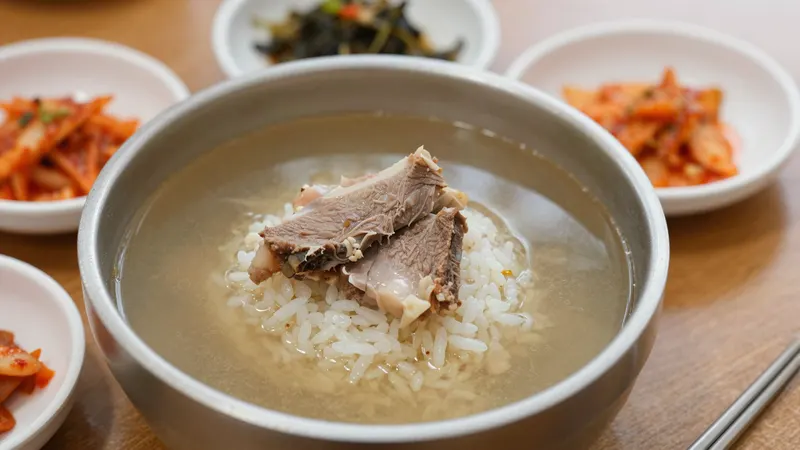
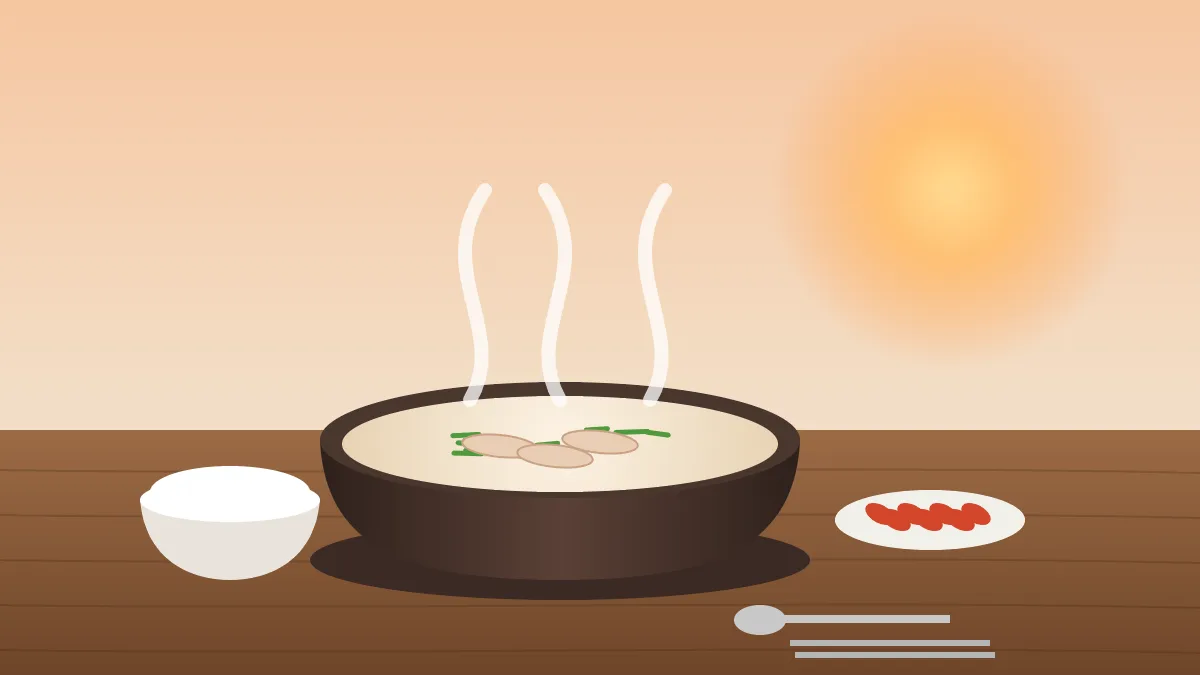
Dwaeji gukbap (돼지국밥) is pork broth poured over rice, either in the same bowl or with the rice served separately on request (따로국밥). The pork itself ranges from lean cuts to fattier ones, and it's worth knowing the dish it's most often confused with: sundae gukbap, which uses offal and blood sausage, is a different bowl entirely — dwaeji gukbap is built on pork meat, not organs.
It arrives unseasoned on purpose, with a tray of add-ins alongside it — this isn't the kitchen forgetting a step, it's how the dish is meant to work. You finish it yourself at the table.
An official Busan Future Heritage — with an origin nobody's fully settled
In July 2025, the city of Busan formally named dwaeji gukbap a Busan Future Heritage, an official recognition of dishes and traditions the city considers part of its identity going forward. Even the city's own heritage page doesn't pin down an exact origin story, though it places the dish around the Korean War, when Busan absorbed a huge wave of refugees fleeing south and food was scarce. One account traces it specifically to market food from Miryang that spread through Busan and South Gyeongsang during the war years.
What's not in dispute is that it stayed almost entirely a regional dish. Even today it's genuinely hard to find dwaeji gukbap much outside Busan and the surrounding Gyeongsang region — this isn't a dish that traveled the way bibimbap or bulgogi did.
Seasoning it yourself
A tray of add-ins comes with the bowl. Dadaegi, a red chili paste, goes in a spoonful at a time for heat. Saeujeot, salted fermented shrimp, functions as the salt — add it gradually and taste as you go, since it's stronger than it looks and isn't something to dump in all at once. Jeongguji muchim, seasoned garlic chives, gets stirred on top; Busan calls these chives jeongguji rather than the standard Korean word buchu, which is a small sign of how local this dish and its vocabulary both are.
Some tables still have a salt shaker sitting on them out of old habit, but saeujeot is doing that job already — reaching for salt on top of it tends to oversalt the bowl rather than improve it, more a rookie move than a rule anyone enforces.
Broth styles differ shop to shop
No two shops agree on the broth. Some boil bones for hours to get a milky, cloudy result; others build the stock from meat alone and keep it clear and noticeably lighter. Some warm the rice by ladling hot broth over it repeatedly before serving (a method called toryeom), while others simmer everything together and serve it straight from the pot. None of these is the 'correct' version, and disliking one shop's take doesn't mean the dish itself isn't for you.
Busan Ilbo, the city's major daily paper, runs an ongoing project called Busan Pork Soup Road that catalogs about 30 long-running shops across the city by exactly these traits — broth color, whether seasoning comes mixed in or separate, and how long the shop has been open. It's a useful way to see the range if you want to compare styles deliberately, though it's the paper's own curated list rather than a personal recommendation from this site.
Where to start if you don't want to research it: Seomyeon has a well-known cluster of shops, there are long-running places near Busan Station, and almost every residential neighborhood has at least one. This is one of the dishes most worth eating away from the tourist areas rather than at a single famous address, alongside the rest of the city's signature food.
Why it topped a survey of Taiwanese visitors
In a 2025 Busan Tourism Organization survey of 15,796 Taiwanese tourists asking which Busan food they preferred, dwaeji gukbap came out on top at 66.9% (respondents could pick more than one dish) — ahead of Busan-style fish cake at 37.4%, seed hotteok at 22.4% and grilled eel at 19.4%. Taiwan has sent more visitors to Busan than any other country so far this year, which makes the result a reasonable signal of what a first-time visitor from a similar East Asian food culture tends to actually enjoy, rather than a dish that mainly appeals to a Korean palate.
The popularity reached further than restaurant tables: a Busan-Taiwan route carrier, Tiger Air, sold more than 2,166 dwaeji gukbap in-flight meals over four months in 2025 — a fairly specific sign that this isn't just a dish tourists happen to try once they land, but one some are already looking for before they arrive.
Frequently asked questions
What is dwaeji gukbap?
A Busan specialty of pork broth poured over rice, either in the same bowl or served separately on request. It's built on pork meat rather than offal — that's what separates it from sundae gukbap, which uses blood sausage and organs. It comes unseasoned, and diners finish it themselves at the table.
How do you season dwaeji gukbap?
Dadaegi (red chili paste) goes in for heat, saeujeot (salted fermented shrimp) functions as the salt and should be added gradually since it's stronger than it looks, and jeongguji muchim (seasoned garlic chives) gets stirred on top. Reaching for a salt shaker on top of the saeujeot tends to oversalt the bowl rather than improve it.
Where does dwaeji gukbap come from?
Its exact origin isn't settled even by the city's own account — Busan's Future Heritage page places it around the Korean War, when refugees flooding into the city faced severe food scarcity, with one theory tracing it to market food from Miryang that spread through Busan and South Gyeongsang during the war. It was formally named a Busan Future Heritage in July 2025.
How much does a bowl of dwaeji gukbap cost?
Around 9,000 to 10,000 KRW at a typical local shop, similar to other everyday Korean meals in Busan.
Where should I go for dwaeji gukbap?
Seomyeon has a well-known cluster of shops, there are long-running places near Busan Station, and almost every residential neighborhood has at least one — it's a dish worth eating away from the tourist areas. Busan Ilbo's Busan Pork Soup Road project catalogs about 30 long-running shops by broth style if you want to compare deliberately.
Why is dwaeji gukbap so popular with Taiwanese tourists?
A 2025 Busan Tourism Organization survey of 15,796 Taiwanese visitors found 66.9% named it their preferred Busan food, ahead of fish cake, seed hotteok and grilled eel. Taiwan sends more visitors to Busan than any other country, and the dish's pork-and-broth base translates well for visitors from a similar East Asian food culture.