At a glance
- What it is
- Hoe (회) — fish sliced raw from a live fish, eaten with chojang (chili-vinegar sauce) and lettuce wraps
- How it works
- Buy a live fish at a ground-floor stall, then eat it at a restaurant upstairs that charges per person for sauces, sides and the table
- Jagalchi Market
- 05:00–22:00, closed the 1st and 3rd Tuesday — Jagalchi Station Exit 10 or Nampo Station Exit 2, about 6 minutes on foot
- Millak (Gwangalli)
- Millak Hoe Town, 09:00–02:00 depending on the shop — Gwangan Station Exit 3, about 18 minutes on foot
- Prices
- Set by weight and season at each stall — ask the price per kilogram and the weight before the fish is killed
What hoe is
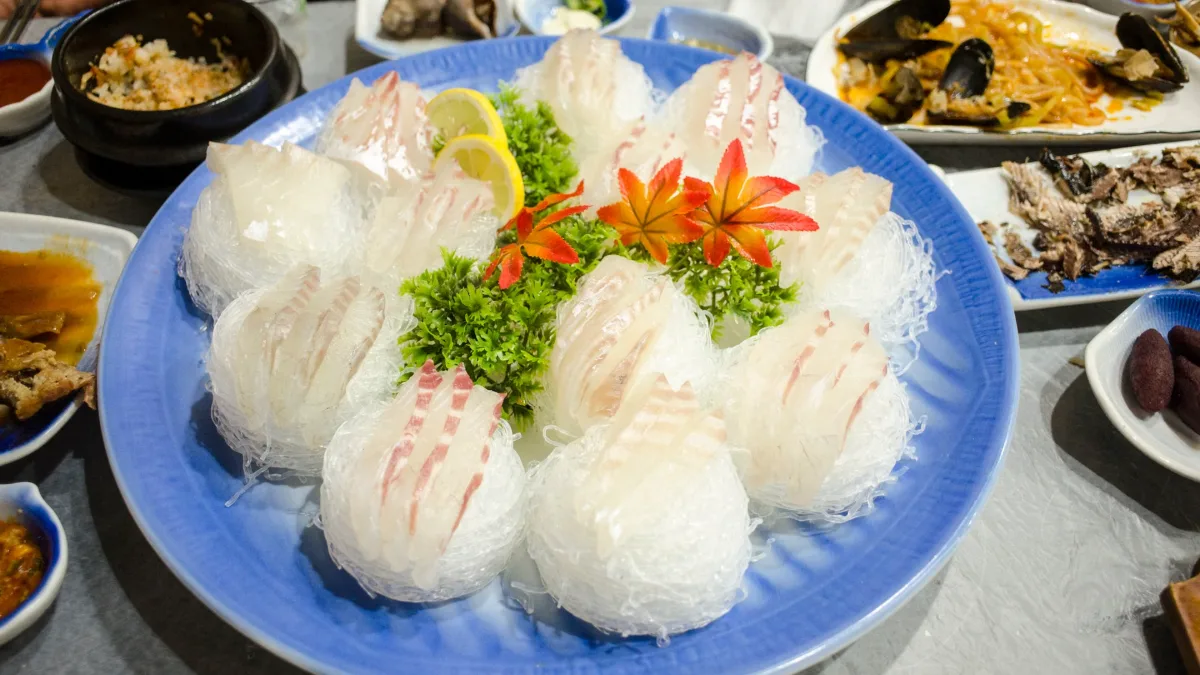
Hoe (회, pronounced roughly "hweh") is raw fish sliced to order. It is close to Japanese sashimi, but the usual Busan version is hwareo-hoe (활어회): the fish is alive in a tank until you choose it, and it is sliced within minutes, so the flesh is firm and slightly chewy rather than soft. A platter usually comes as one kind of fish or as modeum-hoe (모둠회), a mix of several.
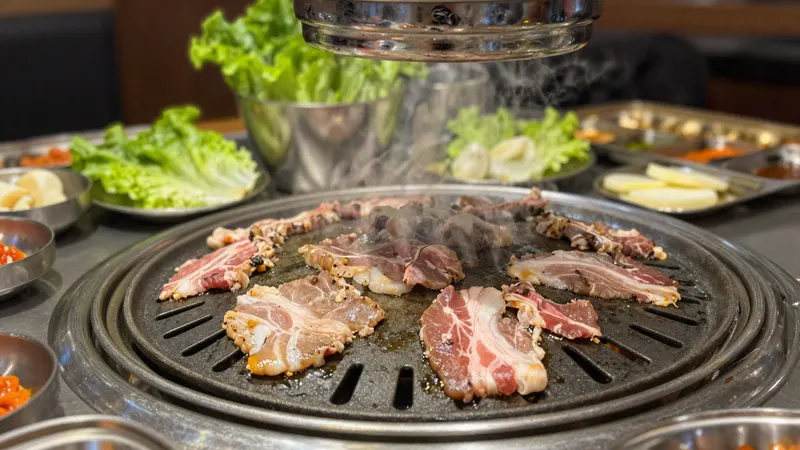
It is eaten with chojang (초장), a red sauce of chili paste and vinegar, or with ssamjang and soy sauce with wasabi, and often wrapped in lettuce or perilla leaves with garlic and green chili. What is left of the fish — the head and bones — usually goes into maeuntang (매운탕), a spicy stew that comes at the end of the meal for an extra charge.
Visit Busan's own food pages put it plainly: "Any trip to Busan wouldn't be complete without some sliced raw fish." If raw fish is not for you, the grilled options in our grilled eel guide come from the same markets.
How the two-step system works
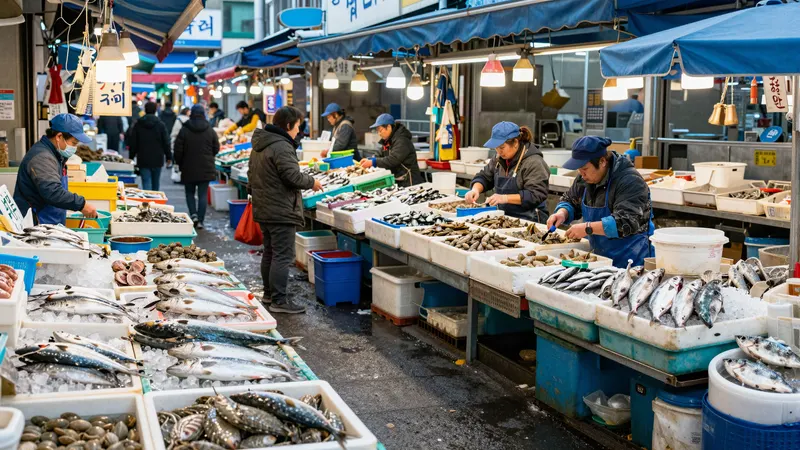
At both of Busan's big raw fish areas, the fish and the meal are sold separately. On the ground floor, stalls keep live fish in tanks. You choose a fish (or a mix), agree on a price, and it is killed and sliced for you — by the stall, or in some buildings by the restaurant upstairs. You then carry the plate — or a stall worker walks you — to a restaurant on an upper floor.
That restaurant is often called a chojang-jip (초장집), literally a "chili-sauce house." It does not sell the fish you brought; it charges a per-person fee for the table, sauces, lettuce and side dishes, usually called sangcharim-bi (상차림비). Maeuntang made from your fish's bones, rice and drinks are added on top. Visit Busan lists these service fees at both Jagalchi and Millak as differing by store, so ask before you sit down.
Some upstairs restaurants also sell their own platters from a menu, which is simpler if you don't want to bargain at the tanks. Either way, the total is fish plus table fee plus whatever you add.
What to ask before you pay
- The price per kilogram (킬로에 얼마예요?) and the weight of the fish you chose — before it is taken out of the tank and killed
- Whether that price is for the whole fish or only the sliced meat, and whether the head and bones are packed for maeuntang
- The per-person table charge upstairs, and whether maeuntang is included or extra
- For anything listed as sigga (시가, "market price"), the actual price for today — ask before ordering, not after
- Write the numbers down or type them into a calculator app on your phone so both sides agree on the total
Jagalchi Market
Jagalchi is the old-town option, on the harbor in Nampo-dong. The modern market building has live fish tanks on the ground floor, and Visit Busan notes you can eat "fresh sliced raw fish while appreciating the sea view." Both Visit Busan and VisitKorea list the hours as 05:00–22:00 and closed on the first and third Tuesday of the month; Visit Busan also lists the fifth Tuesday, in months that have one. Individual stalls keep their own hours, so go well before closing.
Getting there: Visit Busan gives a 6-minute walk from Exit 10 of Jagalchi Station or Exit 2 of Nampo Station, both on subway Line 1. Buses 27, 41, 5-1, 61, 113, 30, 6, 7, 71 and 86 stop at Jagalchi Market or Sindonga Market. It pairs easily with Gukje Market and BIFF Square, a few minutes' walk away.
The Busan Jagalchi Festival, the market's annual seafood festival, runs October 15–18, 2026 according to the City of Busan's fall festival calendar — expect bigger crowds and extra stalls on the waterfront those days.
Millak, at the end of Gwangalli Beach
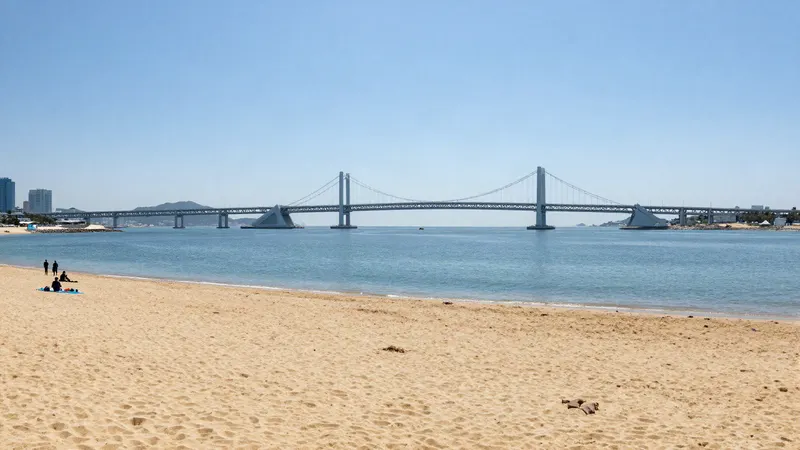
The other cluster is in Millak-dong, at the northern end of Gwangalli Beach, where the restaurants look straight at Gwangan Bridge. Visit Busan points to the raw fish restaurants of Millak Fresh Fish Street and the Fresh Fish Town; two buildings are the easiest to find. Millak Hoe Town (민락회타운) is a tall building where, in Visit Busan's words, you "buy raw fish on the first floor's live fish market" and eat on the floors above with a view of the bridge; Visit Busan lists it as open every day, 09:00–02:00, with hours that differ by shop. Next to it, the Millak fishermen's live fish market (민락어민활어직판장) at 60 Gwanganhaebyeon-ro 312beon-gil is listed by VisitKorea as open year-round, with restaurants upstairs serving sea bream, flatfish, rockfish and flounder.
Getting there: Visit Busan gives an 18-minute walk from Exit 3 of Gwangan Station on Line 2. By bus, get off bus 210 at the Jinro Beach Apartment stop, or buses 38, 41, 83, 83-1 or 108 at Millak Golmok Market and walk about 7 minutes. Visit Busan notes paid parking at Millak Hoe Town, and VisitKorea lists parking at the fishermen's market.
One thing that has changed: you will still see advice online to buy a takeaway platter and eat it in Millak Waterside Park next door. Visit Busan's page for the park notes it has been an alcohol-free zone since July 1, 2023, so a beer or soju with your hoe there is off the table. Eat upstairs, or take the fish back to your room.
What's in season
Visit Busan's food tour sums up the year in one line: "Springtime is the season of flounders, summer croakers, fall gizzard shad, and winter yellowtail." In Korean those are dodari (도다리) in spring, mineo (민어) in summer, jeoneo (전어) in fall — often grilled as well as eaten raw — and bangeo (방어) in winter. Gwang-eo (광어, olive flounder), ureok (우럭, rockfish) and domi (도미, sea bream) are available year-round and are the usual default on most menus.
If you are visiting in October, gizzard shad is the seasonal pick; from late fall into winter, yellowtail takes over.
Words to know
- 회 (hoe) — sliced raw fish; 활어회 (hwareo-hoe) — sliced from a live fish
- 모둠회 (modeum-hoe) — a mixed platter
- 광어 (gwang-eo) olive flounder · 우럭 (ureok) rockfish · 도미 (domi) sea bream · 도다리 (dodari) spring flounder · 전어 (jeoneo) gizzard shad · 방어 (bangeo) yellowtail
- 초장 (chojang) — chili-vinegar dipping sauce
- 상차림비 (sangcharim-bi) — the per-person table charge upstairs
- 매운탕 (maeuntang) — spicy stew made from the fish bones
- 시가 (sigga) — "market price"; ask for today's figure
Frequently asked questions
How do you eat raw fish at Jagalchi Market?
Choose a live fish at a ground-floor stall, agree on the price and weight, and have it sliced. You then eat it at a restaurant upstairs, which charges per person for the table, sauces and side dishes; spicy stew from the bones is extra. Visit Busan lists the market as open 05:00–22:00 and closed on the first and third Tuesday.
What is the table charge for raw fish in Busan?
Upstairs restaurants at Jagalchi and Millak charge a per-person fee, usually called sangcharim-bi, for the table, chili-vinegar sauce, lettuce and side dishes. Visit Busan lists it as differing by store, so ask the amount — and whether maeuntang stew is included — before you sit down.
Jagalchi or Millak — which is better for raw fish?
Jagalchi is easier to reach on subway Line 1 and fits a day in the old town. Millak, at the end of Gwangalli Beach, is an 18-minute walk from Gwangan Station but has restaurants facing Gwangan Bridge and stays open later — Visit Busan lists Millak Hoe Town until 02:00, depending on the shop.
Can I eat takeaway raw fish in Millak Waterside Park?
You can sit there, but the park has been an alcohol-free zone since July 1, 2023, according to Visit Busan, so drinking with your meal is not allowed. Eating upstairs at the raw fish buildings next door is the usual alternative.
What raw fish is in season in Busan?
According to Visit Busan, flounder in spring, croaker in summer, gizzard shad in fall and yellowtail in winter. Olive flounder, rockfish and sea bream are available all year.